
The Tricolor deck is a special deck with some special and unique properties.
Each card has three suits and three ranks and the sum of each rank on a card always adds to 7.
Origin
A friend on discord once asked me about making a deck based on a triangle graph.
Triangle graphs are special graphs with a unique property: Any point on the graph is a ratio between three different things always adding up to 100%.
Take this as an example:
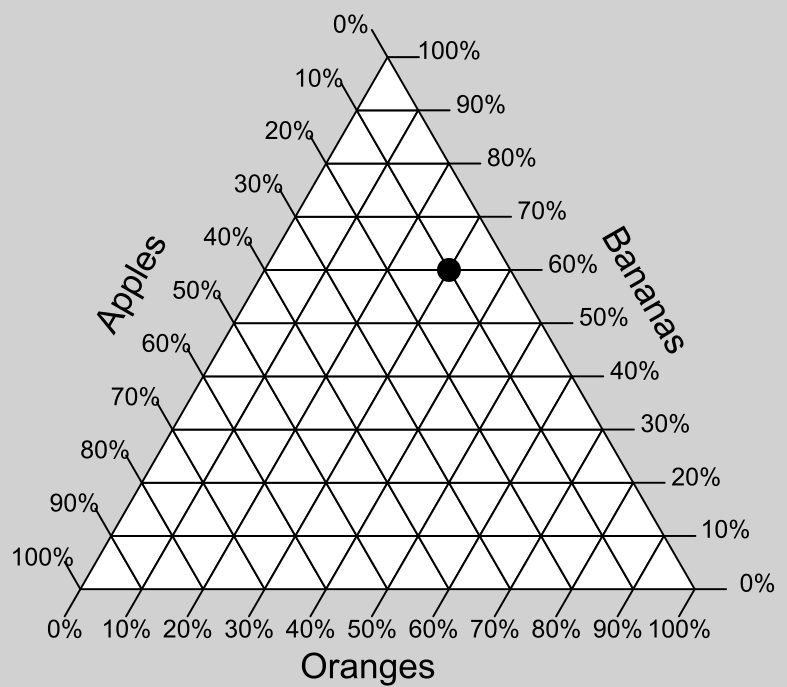
This triangle graph shows a fruit bowl with three different fruits. The contents of the fruit bowl is 10% apples, 30% oranges, and 60% bananas. 10+30+60=100. Any given point on this board adds to 100%.
Okay, cool, let’s make a deck out of it.
Pretty early I settled on using the colours yellow teal and orange for it. I’m not exactly sure why I chose those three, but I did and I stuck with it for the whole design.
I landed on using the numbers 0-7 for the deck pretty early on, as this makes for a 36 card deck. 36 cards in a deck is particularly nice as it divides into a lot of player counts without being too unwieldy a deck. With that in mind you’d get something like this:
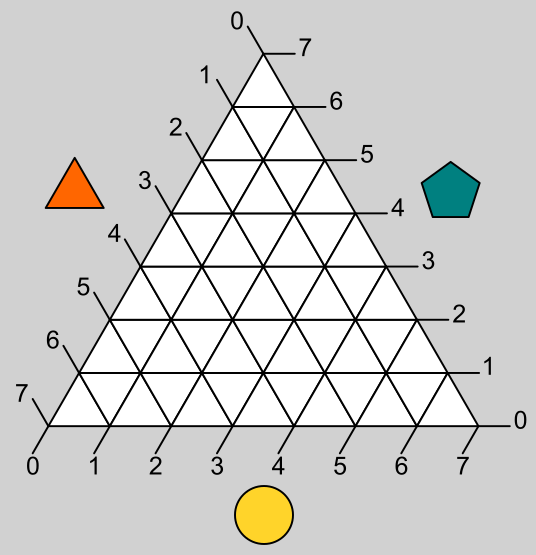
36 unique points, each adding to 7.
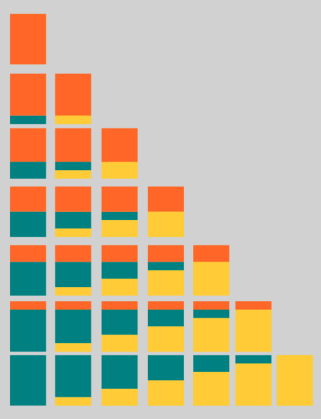
This is an early prototype of the deck with yellow on the bottom. The final deck has yellow in the middle instead.
Introducing the Tricolor Deck
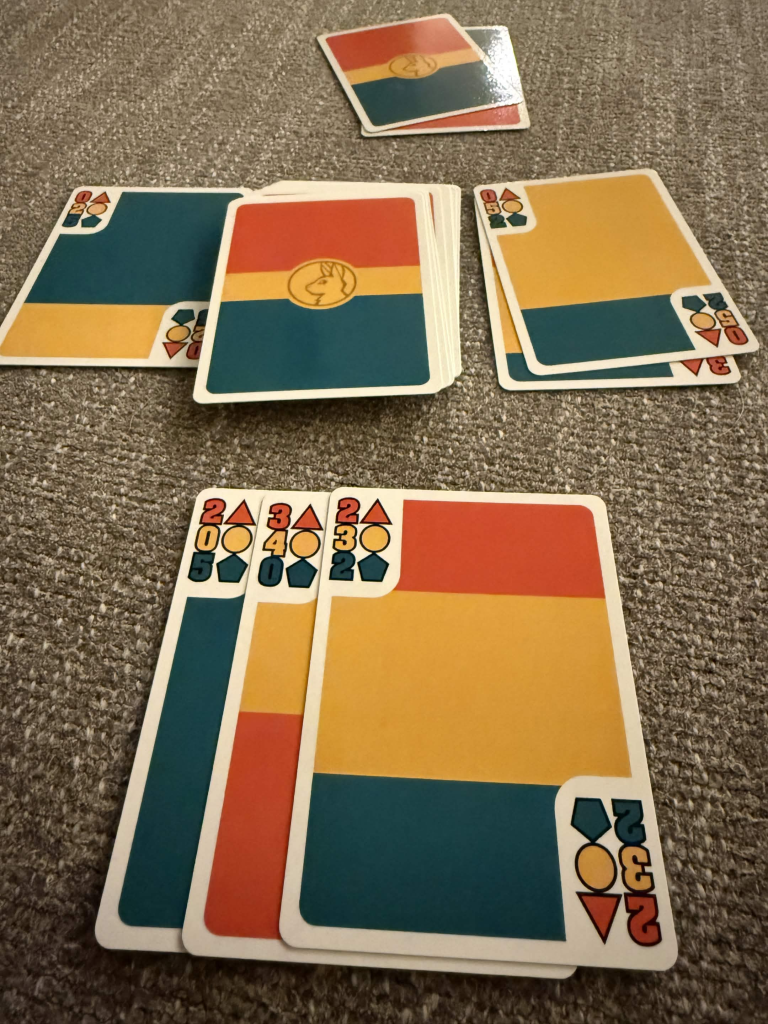
As mentioned, the Tricolor deck is 36 three-suited cards where all the ranks always add to 7.
The deck does have a number of cool features, which I’ll rattle off here:
- The rank distribution in each suit mirrors that of a triangle deck, but in reverse. There are eight 0s, seven 1s, six 2s, …. two 6s, and one 7.
- The sum of each colour is 84, and the total sum of numbers across the whole deck is 252.
- Yellow is always in the middle.
- If a card has a 7 on it, the other two colours are guaranteed to be 0.
- None of the cards have an equal amount of every colour.
- Only four cards distribute yellow equally: 070, 151, 232, and 313.
The deck wasn’t made with any particular games in mind, but more as a platform for me to design games on myself.
I also invite other designers to come up with their own games for the deck and even make their own re-themes of it.
If 36 cards is too little, bringing the highest number all the way up to 10 will give you 66 cards to play with, though unlike most decks, there isn’t a good way to strip cards out without messing with the distribution.
Where Can I Buy It?
The deck is available on The Game Crafter here.